9/22/2025
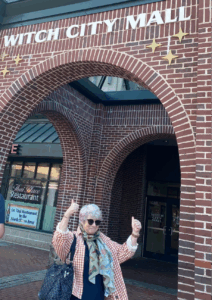
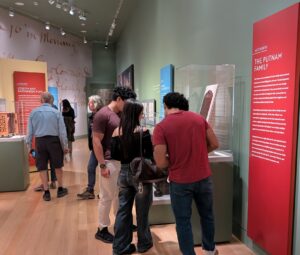
Dr. Leslie Lindenauer, Honors Faculty member and professor of History, teaches a new honors course, HON 298 – Conversing with the Devil, centered on the Salem Witch Trials as well as the evolution of the historical narratives surrounding them. On September 13th, Kathwari Honors Program students enrolled in the course traveled to Salem, Massachusetts to examine how the city tells the story of the trials.
The field study is essential to the course, and students complete a project based on their experience. Salem is a popular fall destination, with over one million visitors each October. Dr. Lindenauer invites students to consider the question, “What does ‘hard history’ look like when it’s shared and displayed in public, in a place that depends on tourism as a major contributor to its economic health?” With all of the fall festivities, it may be easy to overlook the deadly outcome of the trials, which led to the deaths of twenty people. Dr. Lindenauer highlights the relevance of this subject. “At a time when we are being discouraged from confronting some of the darkest history in the American past in favor of a sanitized celebration of our American heritage, what responsibility do we have to face the complexity of the past as a way of understanding who we are today?”
This interdisciplinary course begins with an in-depth study of the Salem Witch Trials. Students read primary sources from the seventeenth century, including texts on European witch trials, daily life in Puritan society, and the complete Salem trial records. The goal is to examine the social, political, cultural, economic, and religious context of the trials, while also considering the role of gender constructions, mass hysteria, and the power of belief systems. The second half of the course focuses on how the trials have been portrayed by successive generations, from the works of Nathaniel Hawthorne to The Crucible and modern media representations. Students are asked to assess how narratives of the trials are shaped to serve new cultural purposes.
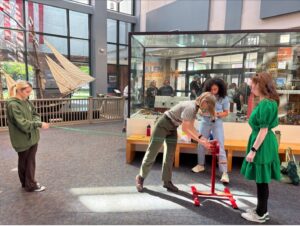
The trip itinerary included stops at the Salem Witch Museum, the Peabody-Essex Museum, the Salem Armory, and the Salem Witch Trials Memorial. Students also had a chance to explore the city on their own, allowing them to see Salem both as tourists and as scholars. Overall, the trip was a chance for 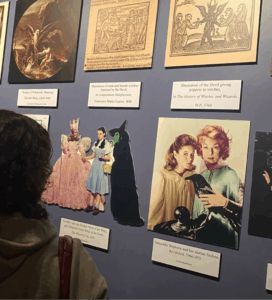 students to apply a critical lens to how history may be altered in its retellings. Students also had a chance to gather ideas for their final project, which includes the option to create their own public history exhibit. Thanks to the generous funding from the Kathwari Family, students were able to have this crucial field work experience and explore how history interacts with the present.
 .
.