

Never one to sit still, Dr. Theodora Pinou has been globe-trotting with the goal to document biodiversity and instill a love of STEM in students
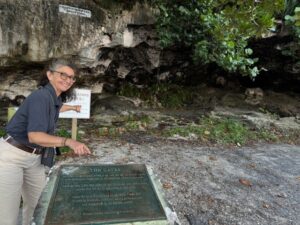
Dr. Theodora Pinou in the Bahamas.
Western Connecticut State University Professor of Biology Dr. Theodora Pinou has accumulated quite a few frequent flyer miles during the past year — but the travel hasn’t been for vacation — it’s been to further her research into biodiversity and wildlife protection. Pinou, who took students to Costa Rica in January 2025, and Greece during Spring Break 2025, just returned from a solo trip to the Bahamas in November 2025. And while the native species she studies are different in each location — global sea turtle epibiomes, especially those in Costa Rica; local wildlife affected by climate and natural disasters in Greece; and snakes in the Bahamas — the goals remain the same: to provide students the opportunity to participate in experiment design, data collection, and peer-to-peer learning while working to improve the outcomes for the creatures being studied.
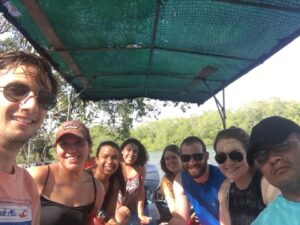
WCSU students who accompanied Dr. Theodora Pinou to Costa Rica.
Pinou has brought students to Costa Rica four times to examine the interspecies relationship between sea turtles, their barnacles, and their epibiomes, the microbial community that lives on the surface of an organism. Another trip is planned for January 2026, and 13 WCSU students will accompany Pinou, with their trips funded by The National Science Foundation (NSF). The cohort of travelers will include Biology majors, nursing, and cyber security majors with Biology minors, and a Political Science student. “It’s a mixture of majors, which is wonderful,” Pinou said. “They’ll work together supporting researchers in the collection of environmental data, specifically sea turtle epibionts, in a peer-to-peer learning environment, which is recognized as an exemplary pedagogical practice. The funding shows that the NSF is blind to what the students are majoring in and that excellence is applied to all majors and all students equally.”
The National Science Foundation has provided a grant for Pinou’s Costa Rican project, entitled “Collaborative Research: Gluers, Grippers, and Gougers: Host-adapted Diversification of Barnacles Epizootic with Marine Megafauna and their Turtlescape Genomics,” and she is collaborating with the Yale Peabody Museum, the Citadel, the University of Georgia, and the College of Charleston on the global sea turtle epibiome initiative.
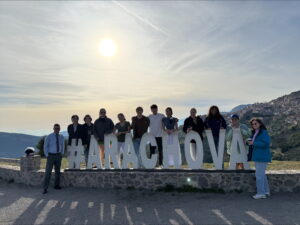
Dr. Theodora Pinou (far right) with her students in Arachova, Greece.
Pinou’s interests in Greece focus on the biodiversity of forests and the impact of severe weather events on diversity. “For example,” she explained, “What happens after a fire? How do organisms recover and recolonize a space after it’s been destroyed?” The answers to those questions are sought by applying sensors in the field to measure and evaluate biodiversity. Pinou said there are two groups interested in the research results: meteorologists and emergency management personnel who look at ways to predict things like adverse weather and fire hazards so they can mobilize vulnerable people to protect them, and scientists who study successional ecology and evolution and how different species interact in the wake of climate or other threats to promote biodiversity. Pinou will travel for her second research trip to Greece in 2026, joined by 12 students whose trips are supported by the Macricostas Family Foundation.
In the Bahamas, Pinou is studying snakes killed by vehicles on Eleuthera and seeking to create enthusiasm for STEM-related research. Bahamians, like many others, are known to fear snakes, according to Pinou, but an unusually large number are being run over at her study locations. Her research seeks to provide a community science educational initiative to study this phenomenon on all the neighboring islands. This work is being done in conjunction with the University of the Bahamas, The Cape Eleuthera Institute, and The Island School, and Pinou was invited by the university, which featured her November 2025 presentation, “Applying CURE (Course-Based Undergraduate Research Experiences) in Creative Activity and Scholarly Research.” As a result of this latest collaboration, Pinou is being considered for a Fulbright Specialist Award.
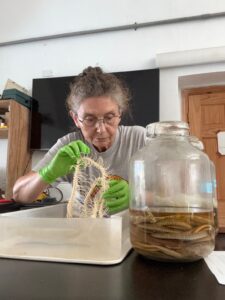
Dr. Theodora Pinou examines a specimen collected in the Bahamas.
“STEM education is the priority,” Pinou said. “Because of my work, I’m considered an expert in applying natural history collections in the classroom. This ties in with my National Science Foundation grant and sea turtle research. I plan to continue to look at interspecies relationships with the help of grants and funding that the university has obtained to support my work.”
Thermal regulation along coastlines is another offshoot of Pinou’s research interests, and, along with WCSU Biology graduate students, Pinou studies why terrapins migrate onto Fairfield County roadways and what can be done to protect wildlife and avoid vehicular collisions. As a result, she is regularly in communication with state and coastline collaborators to find solutions to safeguard turtles and other animals.
Also, locally, Pinou also is part of the Danbury Sustainable Connecticut Mayor’s Group that is looking at building community resilience and earning Climate Leader designation. Ideas she is working on include wildlife movement and corridors, wetland restoration by native plants, and migration between urban pollinator gardens. “Our new president, Dr. Bernal, has expressed his mission of having the university be more involved with the city in which we are located,” Pinou said. “We need to make ourselves an even more native plant and pollinator-friendly campus by building additional green spaces.” Pinou’s contribution on this Danbury committee will help achieve this goal.
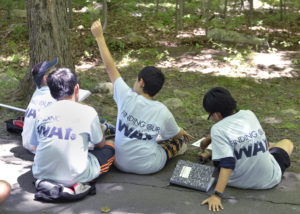
Young students participating in the “Finding Our Way” STEM outreach program.
In addition to her field research, Pinou received a NOAA grant to promote experiential learning with the goal to bring students who may be struggling with research skills to the same level as those who self-identify as environmentalists. This has been accomplished through the Bay Watershed Education and Training (B-WET) Program and the establishment at WCSU of “Finding Our Way,” a hands-on learning program that gets students involved in the environmental sciences of their surroundings and fosters lifelong interest in protecting our environment. These results are part of a graduate student’s thesis, and Pinou looks forward to publishing the findings in collaboration with the Danbury Public Schools’ team of teachers and administrators that collaborated on the project.
She’s also the faculty steward of the Herndon Dowling Jr. Herpetological Collection at WCSU. Dowling was Pinou’s professor and upon his death, his wife entrusted his collection to Pinou’s care. It’s a highly sought after compilation of data and drawings that benefit graduate students in the university’s Master of Science in Biological Diversity program, Pinou said. “On every field trip I take my students on, I try to recreate the excitement that I experienced as one of Herndon’s students,” she added.

Dr. Theodora Pinou on Candlewood Lake.
Pinou has been on sabbatical for the fall 2025 semester, and it has enabled her to be “really productive,” she said. “It has allowed me to focus on my research, what I’m doing, my NSF grant, and how I can support the university’s priorities, and the nation’s priorities. What will my legacy be, and what can I leave behind? It allows me to be focused.”
Next up: After returning from her November trip to the Bahamas, Pinou will embark for Costa Rica in January, followed by Greece during WCSU’s Spring Break. The biology professor’s migratory pattern continues …
Western Connecticut State University changes lives by providing all students with a high-quality education that fosters their growth as individuals, scholars, professionals, and leaders in a global society. Our vision: To be widely recognized as a premier public university with outstanding teachers and scholars who prepare students to contribute to the world in a meaningful way.