Search WCSU
WCSU Essentials
Automatic translation disclaimer
Translation of this page is provided by the third-party Google Translate service. In case of dispute, the original language content should prevail.
La traducción de esta página la proporciona el servicio Google Translate de terceros. En caso de disputa, prevalecerá el contenido del idioma original.
La traduction de cette page est fournie par le service tiers Google Translate. En cas de litige, le contenu de la langue originale prévaudra.


New WCSU science class turns the chemistry lab into a crime scene investigation
Dr. Forest Robertson
It’s a hard case to crack – how to get non-science majors excited about a lab course. Western Connecticut State University Professor of Chemistry Dr. Forest Robertson believes he has found the answer.
Robertson offered CHE105 for the first time in fall 2025, and the evidence is overwhelming that he’s on to something.
‘I created this course to offer WCSU students, many of them majoring in Criminal Justice with the Criminology option, a lab science course that aligns with their career aspirations,” Robertson said. “Additionally, I wanted to create a lab experience that would give the students skills that can be applied to solving real-world problems that include, but are not limited to, chromatography (forensic drug testing), gel electrophoresis (DNA fingerprinting), blood analysis, fingerprint analysis, and many others.”
Robertson continued, “I have dreamed of contributing to the development of a forensic science major and/or minor here at WCSU because many of my students over the years have indicated their interest in such a major and there is a shortage of forensic scientists in the State of Connecticut; this course would perfectly support this endeavor.”
His intended audience clearly saw the signs. Sixty percent of the inaugural cohort was comprised of Criminal Justice majors, followed by 13.3% Psychology majors, 6.7% Finance majors, and 3.3% each students majoring in Management, Mathematics, and MAT Secondary Education (a graduate degree). Exploratory Studies students comprised another 10%.
According to Robertson, “The course attracted 30 students in its first offering. This is a chemistry course for non-science majors and 93% of the students passed.”
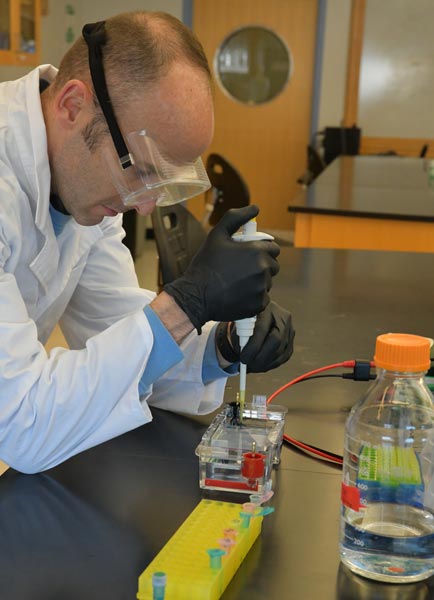
He added, “The class learned a lot of forensic science through a chemical lens. For example, the students were able to calculate the estimated time of death of a murder victim based on blow fly larvae data and temperature data. In the lab, the students investigated blood stains using luminol, performed blood-typing analyses, investigated and compared the DNA of five potential suspects to crime scene DNA via gel electrophoresis (100-level students ran beautiful gels!), and performed four types of fingerprinting analyses.”
Robertson said the course was a joy to offer, and the evidence reveals that it was enjoyable to attend, too.
Anonymous student evaluations of the lectures offered proof: “ Dr. Robertson was very enthusiastic about the material and it definitely, positively affected the whole class,” one wrote. “Dr. Robertson was great and easy to work with. You can tell he really cares about the course and his students,” said another. “You can tell the instructor is very passionate about the subject which allows learning to be easier,” said a third. And what could be better than a review like this: “Dr. Robertson is an extremely helpful professor and was invested in the material and helping students. Made me want to major in Chem.”
The feedback from the lab classes was no less effusive. “All of the labs were fun and still utilized the concepts learned in lecture. One of the more fun lab classes I’ve had the privilege to take,” said a respondent. Another student wrote, “Labs were awesome!” and another reported, “The labs were engaging and really connected to our lesson.”
Robertson believes he’s proven his case that you can, in fact, engage non-science majors in a chemistry lab environment, and hopes to offer sections each semester in the future to allow more students to participate. The evidence, it is clear, is irrefutable.