

Terry Dwyer’s career experiences come into play in the classroom and beyond

New York State Trooper Terrence P. Dwyer with his wife, Joan, circa 1989.
During the last weekend in September, Western Connecticut State University and Connecticut State University (CSU) Professor Terrence Dwyer traveled to the 2025 Scranton Fringe Festival for the premiere of his 12th play, Depositions. This might seem like a typical occurrence for a professor of script writing or theatre, but Dwyer, a retired New York State Police investigator and an attorney, is a professor of Justice and Law Administration (JLA) who has found a way to blend his career experiences with his creative endeavors.
As he prepared to head to Scranton for the staging of his latest play, Dwyer explained, while laughing, that he always had an interest in literature and writing, but fell in with a “bad crowd” and ended up becoming a police officer and then fell in with an even worse crowd when he became an attorney.
After 22 years with the New York State Police, Dwyer opened a law practice, originally intending to focus on criminal law, real estate law and estate planning. But his roots in law enforcement led him down a different path and soon he found himself specializing in labor and employment law as counsel to two law enforcement unions representing over 1,100 officers. For 15 years, Dwyer represented law enforcement officers in contract negotiations, grievances, critical incidents, and in more than 200 disciplinary cases. As a plaintiff’s attorney, he represented police officers in workplace discrimination and sexual harassment litigation.
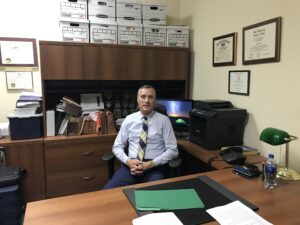
Terrence P. Dwyer at his law office.
Dwyer explained, “I had a female supervisor for nearly a decade in the New York State Police, and she was the best. I saw the disparity in how she was treated and the trickle-down harassment male investigators endured because of working for her. It gave me a window into gender discrimination and sexual harassment. Later, as an attorney I had cases where my female police officer clients had been sexually assaulted by male supervisors. I decided to take a sabbatical from my teaching position at WCSU in fall 2020 to gather data on what I had observed as a police officer and in my law practice.”
Delving into media reports of cases involving female officers who had initiated gender discrimination, sexual harassment or sexual assault charges against their peers or supervisors, Dwyer began to build his dataset of 225 cases nationwide. He presented his early results at the Academy of Criminal Justice Sciences in Baltimore, Maryland, then in Denver, Colorado, and at the 2024 International Police Executive Symposium in Thessaloniki, Greece. He also connected with the founders of the 30×30 Initiative, a nationwide organization to advance women in policing. According to the 30×30 website, their goal is to increase the representation of women in policing to 30% by the year 2030 and to ensure that policies and the working culture intentionally support the success of qualified women officers throughout their careers.
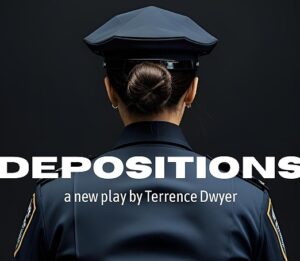
Dwyer published his sabbatical research studies and soon after, female police officers from across the country began to reach out to share their stories. He recently surveyed more than 512 respondents about their experiences to add to his news media research. As his databases grew, so too did his desire to reach a broader audience than he was able to at academic conferences. His one-act play, Depositions, is the result.
At the Scranton Fringe Festival, Depositions was described as “a drama that explores themes of gender, power, and institutional failure through the experiences of female police officers. … It highlights the struggles, silence, and resilience of women in a male-dominated profession and uses real-world accounts and testimonies to draw its narrative, aiming to inspire reflection and dialogue.”
Dwyer said, “I wrote this from my broad-based experience as a detective, from representing clients in my law practice, and from the research I compiled. Most importantly, through the voices of actual female officers, the play represents the real-life experiences of many women in policing. The play gives this information a forum, and even though it’s not my first play, it’s the first one I’ve written about law enforcement. It was well attended with positive feedback and will be staged again. I’ve already had an inquiry about producing it elsewhere.”
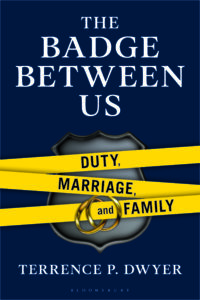 Despite this being his first police-themed play, Dwyer’s bibliography contains numerous texts that relate to his career. Among them: Legal Issues in Homeland Security: U.S. Supreme Court Cases, Questions and Commentary (2014); Business Law: Foundations for the 21st Century, co-authored with WCSU Associate Professor of Justice and Law Administration Thomas Miller, Esq. (2017); Homeland Security Law: Issues and Analysis (2024); and The Badge Between Us: Duty, Marriage and Family. The latter is Dwyer’s first general market book, scheduled for release February 5, 2026, by Bloomsbury Publishing. The book focuses on his police career and the impact on his family life. He presently is working on a new nonfiction true crime book centering on a 50-year-old murder. Dwyer is also the Police Liability and Litigation columnist for Police1.com since 2008, and a featured columnist since 2022.
Dwyer has been writing plays since 2017 that have been, for the most part, staged across New York State. His 2021 play, Apophenia, was selected as a semi-finalist at the Lakeshore Player’s Theater 10-minute Play Contest in White Bear Lake, Minnesota. If Crayons Were Bullets, also penned in 2021, was a Playwright Festival Finalist at the Hopkinton Center for the Arts in Hopkinton, Massachusetts.
He maintains professional contacts as a member of the Dramatists Guild, Playwrights Center, Mystery Writers of America, Public Safety Writers Association, Association of Writers & Writing Programs, National Writers Union, Textbook and Academic Authors Association, Academy of Criminal Justice Sciences, International Law Enforcement and Educators Association, International Association of Chiefs of Police (IACP) – Legal Officers Section, and the Police Executive Research Forum (PERF). Even though he is retired from his law practice, Dwyer serves as a volunteer referral attorney for the Foundation for Individual Rights and Expression (F.I.R.E.).
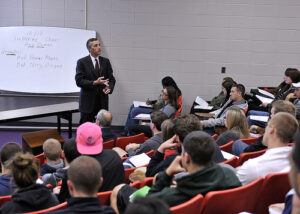
Terrence P. Dwyer in a WCSU classroom.
For over 18 years, Dwyer has brought his insightful and “in the trenches” law enforcement experience into WCSU’s JLA classrooms, where he has taught countless students who hoped to embark on law enforcement or law-related careers after graduation. This year, for the first time, he is teaching an Honors course for students who are members of the Kathwari Honors Program, and may not necessarily be interested in policing careers. According to the syllabus, the course, “Warrior or Guardian? Police Accountability, Misconduct, Militarization, and Purpose in Our Democratic Republic,” seeks to provide students an understanding of the complex and complicated nature of policing in America and will provide an objective examination of policing — the bad, the good, and the in-between — as students develop their own thoughts about the role of the police in our society.
“The Honors course has students from all majors, not just JLA, of course,” Dwyer said. “I have a few theatre students in the class who maybe were a little skeptical about a former police officer as their professor, but I think I resolved whatever stereotype may have been expected when they found out I write plays. I’m not one-dimensional — solely a retired police detective, lawyer, business owner, or writer — I’m all these things, and I think the students get it, and it matters to them. We’re here to teach both the theoretical and the practical, and students come from different backgrounds and have different interests, so when they realize professors are multi-faceted human beings, it’s easier to make a connection and for them to see that they’re not limited in their aspirations. I am always happy to give advice to my students, and the bottom line is that I care, and I want all of them to be successful.”
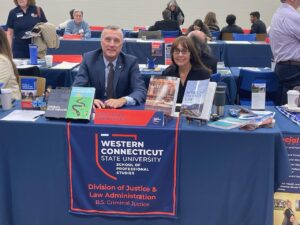
Terrence P. Dwyer representing the Division of Justice and Law Administration at WCSU’s Open House.
Dwyer recently has been in his students’ shoes himself, having added a Master of Arts in Creative Non-Fiction (2024), and a Master of Fine Arts in Creative Writing (2025) from Wilkes University to his existing credentials of a B.A. in English Literature from Fordham University (1985), a J.D. from Pace University School of Law (1991), and a post-graduate certificate in Labor Studies from Cornell University (2010). Dwyer also attended the NY State Police Academy for 24 residential weeks in 1985-86, for certification as a police officer.
“I’m fortunate that I can follow up on my previous dream of writing, and that I’ve been able to pursue my passions,” Dwyer said.
Regardless of whether his audience is WCSU students or theatergoers at one of his plays, they benefit from Dwyer’s ability to uncover the facts and express them effectively. As his professional author’s website so eloquently states, “As a non-fiction writer I bring the inquiring eye of a police detective to a story, while as a playwright I embrace the lyricism and imagery of a poet. Writing is a search for the truth, something I’ve been doing my whole life.”
Western Connecticut State University changes lives by providing all students with a high-quality education that fosters their growth as individuals, scholars, professionals, and leaders in a global society. Our vision: To be widely recognized as a premier public university with outstanding teachers and scholars who prepare students to contribute to the world in a meaningful way.