

A collaboration between Poli Sci Professor Dr. H. Howell Williams and student Chris Powers allows classmates to see ’90s politics from both perspectives
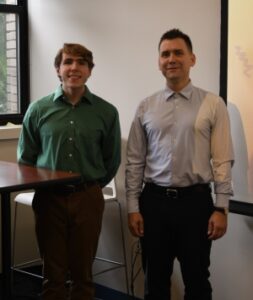
(l-r): Teaching Assistant Chris Powers and Associate Professor of Political Science Dr. H. Howell Williams
If you ask anyone what the most culturally significant song of the 1990s was, most people could recall “Smells Like Teen Spirit” by Nirvana. But, if you asked what the biggest political stories from that decade were, how many could come up with a comprehensive list? Surely, political scientists like Western Connecticut State University’s Dr. H. Howell Williams, who teaches on a range of topics, including American government, political institutions, political theory, and gender and sexuality politics, could come up with key milestones; but it might surprise you that a 21-year-old who wasn’t born until 2004 could put forth a highly detailed rundown as well.
The 21-year-old in question is Chris Powers, a senior in WCSU’s School of Visual, Performing, and Communication Arts. Powers is pursuing a Bachelor of Science in Music Education with the goal to earn a Master of Music in Music Education in order to become a public high school choral director. As a result, he’s in two university choirs, is the principal violist in the orchestra, and started a piano quintet.
In addition to his musical endeavors, Powers is a Kathwari Honors student who loves political science and mathematics, so he has added minors in both subjects — and somehow has found the time to engage in activities that support those interests as well. He has undertaken two independent studies with Mathematics Department Chair Dr. David Burns — one on the relationship between mathematics and music, and another to expand his knowledge of linear algebra — and has co-taught two upper-level Political Science courses with Williams: “The 2024 Election” and “Politics of the 1990s.”
Powers explained that he entered WCSU with 39 AP credits, positioning him as a sophomore before he even set foot on campus. In spring of his sophomore year when looking to register for classes for the following fall semester, he encountered a conflict between a required Music Education class for his major, and a desired Honors Political Science class for his minor. It was at that point that he reached out to Williams — a faculty member that he did not know — and asked if there was any way he could enroll in Williams’ 2024 Election course, even if he could not attend every class due to the conflict. After that initial conversation, not only was Powers registered in the class, but at Williams’ suggestion, he became Williams’ Teaching Assistant (TA), and committed to lead the discussion during four class sessions during the semester.
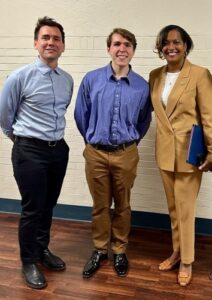
(l-r): Dr. H. Howell Williams, Chris Powers and U.S. Rep. Jahana Hayes, who accepted Powers’ invitation to speak to Williams’ “2024 Election” class.
“Chris is a very enterprising young man,” Williams said. “It was a gamble on my part to suggest having him teach, and it completely paid off. He’s very industrious and hard-working, and he offered a different perspective to the class.”
“Dr. Williams understood that I’m academically self-capable and very comfortable in front of a group,” Powers added. “I further demonstrated that I could do this by contacting U.S. Rep Jahana Hayes to invite her to speak to our class, and she accepted!”
Despite having sufficient political science credits accrued for his minor, Powers still yearned to learn more. When spring registration for the following fall rolled around again, he reached out to Williams to ask what he’d be teaching and whether he could work with him again. Williams indicated that he planned to offer an advanced topics class called “Politics of the 1990s.”
“I was a kid in the ’90s,” Williams, who is 40, said. “When I was an undergraduate student, classes covering the 1960s and 1980s were prevalent, and the ’70s seemed to get lost. I see the 1970s as a response to the ’60s and setting the stage for the ’80s — and this class I am teaching now bridges the 1980s and early 2000s in the same way. I have a lot of interests, and I enjoy offering topical courses like this to illuminate contemporary phenomena.”
Powers was born well after the decade being covered in the class. Nevertheless, Williams agreed not only to the TA arrangement again, but was willing to literally split the class time between himself and Powers to provide students with the dual perspectives of someone who lived through the ’90s and someone who, like most of his peers, had not even been born yet.
Powers and Williams began meeting in June 2025, and Williams sketched out the rough framework for the class. Powers, an extremely detail-oriented individual, started breaking it down further by each class session and what he thought should be covered, based on his own reading and research. The following month, they met to nail down the specifics and who would focus on which topics.
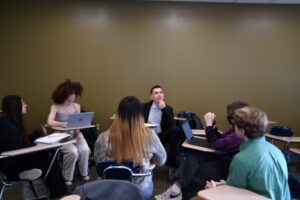
Dr. H. Howell Williams (center) during a class discussion with students in “Politics in the 1990s.” Student TA Chris Powers is to the right.
For the rest of the summer, Powers continued his extensive research and reading, and began to compile content in Google docs. By August, Williams and Powers were able to complete a syllabus that included topics ranging from Civil Rights in the 1990s, film during the decade, the OJ Simpson trial, the fall of the Soviet Union and the Cold War, the relationship between Israel and Palestine, and the impeachment of President Bill Clinton.
“Chris did a lot of the planning, and came up with much of the meat on the bones,” Williams said. “Our interests and focuses are very complementary, but we have very different orientations to the history. We have fundamentally different ways of understanding this period and its politics because of our individual reference points. It’s been a complex learning experience for me to see how distinct our respective political experiences and realities really are.”
For his part, Powers said, “I was shocked at how much I already knew about political events in the 1990s. It’s cool to see in the students’ reflection essays how Dr. Williams’ and my differing perspectives help them see how things that happened in the 1990s are relevant to where we are now and how we got here. One of our best classes, in my opinion, was on Welfare Reform, and I presented the details, or the micro view, and Dr. Williams gave more of a macro look. Both of us working together like this provides a simultaneously broad and in-depth understanding of important political events.”
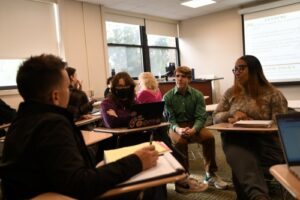
Associate Professor of Political Science Dr. H. Howell Williams (left) and TA Chris Powers (center) during a class discussion in “The Politics of the 1990s.”
Powers continued, “Part of what we’re trying to do is get students to see that things were different in the 1990s. The political world wasn’t as partisan back then. Just look at the Clarence Thomas – Anita Hill hearings in 1991, and the Supreme Court as it stands today. We’re teaching about that right now.”
Williams said, “This really is a testament to Chris. Ordinarily, at this point in the semester, I’d be wrapping things up, but right now there is material that we probably won’t even be able to cover. Because of the dual nature of our interests, we don’t have the time necessary to cover everything.”
Williams added, “The value in this for Chris is that his goal is to be a music educator, and he has a patient way of giving the details, which will be useful when he is working with his future students. His classmates respect him because he puts in the work and is really showing up. I’m so incredibly lucky to work with the quality and caliber of students like Chris that we have at WCSU. I’ve learned a lot, and am much less anxious about doing something like this in the future. This feeds me and keeps me excited about the work that I do.”
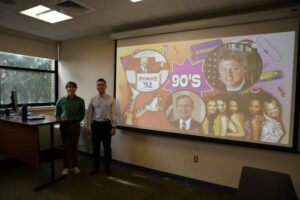
(l-r): Chris Powers and Dr. H. Howell Williams in the “Politics in the 1990s” classroom.
Powers said he believes that he and his professor are very much on the same page and enhance each other’s content. “I’m always into the nitty gritty details and Dr. Williams is always looking at broader trends,” Powers said. “I think my classmates appreciate what we’re both bringing to the class, and how we present it to them. I feel that political science is like a puzzle and I’ve been able to piece the puzzle together; and now I’m trying to help my fellow students understand how to do it, too, in order to comprehend what’s happening right now. It’s amazing as an undergraduate to have an opportunity to work so closely with a university professor like this. Not only has it been really fun and rewarding, but I’m not sure I would have had this kind of opportunity anywhere else.”
“Featuring students in the process of teaching and learning is something we can do here at WCSU,” Williams concluded. “Chris has been a great partner in all of this.”
Western Connecticut State University changes lives by providing all students with a high-quality education that fosters their growth as individuals, scholars, professionals, and leaders in a global society. Our vision: To be widely recognized as a premier public university with outstanding teachers and scholars who prepare students to contribute to the world in a meaningful way.