Search WCSU
WCSU Essentials
Automatic translation disclaimer
Translation of this page is provided by the third-party Google Translate service. In case of dispute, the original language content should prevail.
La traducción de esta página la proporciona el servicio Google Translate de terceros. En caso de disputa, prevalecerá el contenido del idioma original.
La traduction de cette page est fournie par le service tiers Google Translate. En cas de litige, le contenu de la langue originale prévaudra.


Provost's
Distinguished Lecture Series
Advancing Knowledge Through Dialogue and Discovery
This series brings leading voices from across disciplines to share their insights, scholarship, and vision with our community.
A reception will follow each lecture series, offering a chance for conversation and connection.
✸ Free & open to the public.
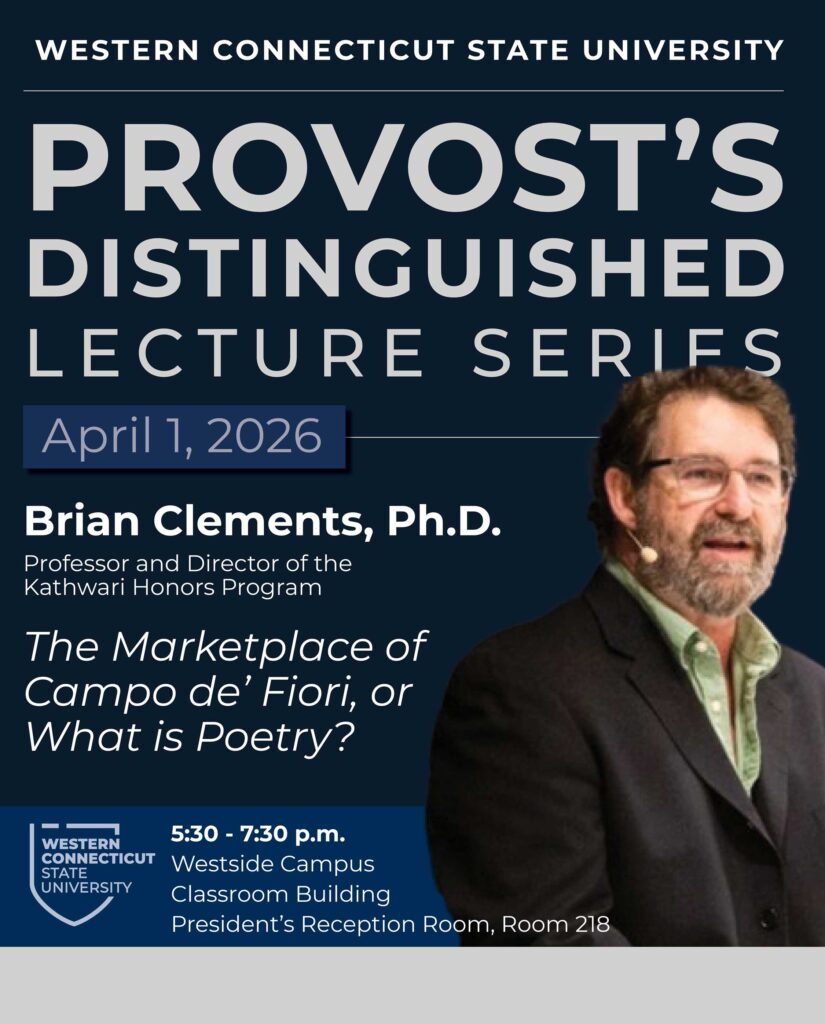
Brian Clements, Ph.D.
Professor and Director of the Kathwari Honors Program
The Marketplace of Campo de’ Fiori, or What Is Poetry?
In the United States, the public often turns to poetry after times of tragedy and forgets about it much of the rest of the time. Poetry receives less funding than any of the other arts. Yet there are more people writing (if not reading) poetry now than ever before, and capital-P Poetry is highly reputable—so much so that we commonly praise songwriters and speechwriters by calling them poets.
In this talk and reading, Dr. Clements will discuss the public and private roles of poetry and the reasons poetry persists in a hyper-capitalist economy where it seems to have little economic value.
Neeta Pardanani Connally, Ph.D.
CSU Professor of Biology
Director, WCSU Tickborne Disease Prevention Laboratory
How to Be a Bad Host: Preventing Lyme Disease When There Are More Ticks in More Places
It has been five decades since Lyme disease was first discovered in southeastern Connecticut. Since then, preventing this illness has proved challenging, with nearly 500,000 cases of Lyme disease occurring in the United States each year. This talk will explore the natural history and geographic spread of disease-causing ticks in the Northeastern United States. The current science of tick prevention will also be discussed.

Terrence P. Dwyer, JD/MFA
Criminals, Clients, Curricula, and Creativity
As an academic, Professor Terry Dwyer has presented at national conferences, published in criminal justice and law journals, authored three textbooks, and been cited in academic articles, course books, and a petitioner’s brief before the U.S. Supreme Court. However, his desire to reach a wider audience and speak on issues important to him, as well as his creative writing interests, led him to reconsider how research is shared with the public.
With a diverse background as a retired police officer and attorney, and many years in academia, he decided to forgo traditional academic writing and present his work as a playwright and author. Professor Dwyer will discuss the three research topics he has been working on and how he took alternate paths to presenting his work.
Professor, Legal Studies
